Showing posts with label ****. Show all posts

Sunday, January 18, 2009

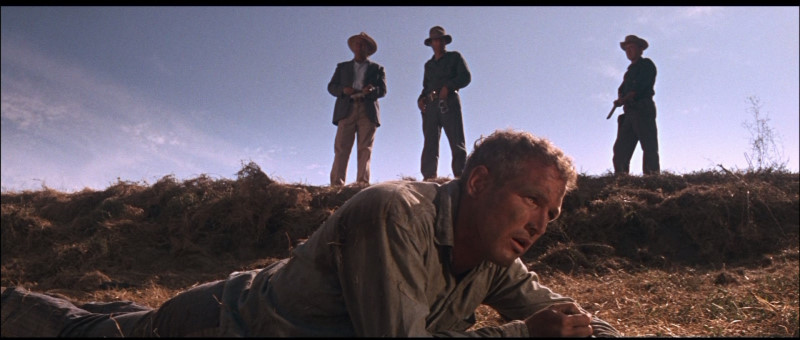
Cool Hand Luke (****)

"What we've got here is... failure to communicate"
-Captain, Road Prison 36

Few movies have caught and inspired the mindset of the public so well as Cool Hand Luke. And even fewer of those films remain fresh and relevant today. Cool Hand Luke is a movie that was rebellious in every way. From its plot, to music, to cinematography, it broke old rules and has truly made its mark on American film.

First, the cinematography. This is easily in my top ten most beautifully shot films list. It hardly looks forty years old. The camera work isn't just beautiful, its innovative. Few movies have been this inventive with their cinematography. The film cuts between extreme closeups to extreme (and symbolic) long shots, with some breathtaking shots dollying in between the two.

The plot features a central character who is an antihero and a Christ figure (whoops, spoilers). He is the opposite of a traditional Hollywood hero. When confronted with a challenge he always takes it, but doesn't always win. He doesn't even conform to the Hollywood bad guy cliche, as he went to prison for disabling parking meters, something that seems insignificant when compared with the crimes of his bunk mates.

With all the recent remakes and adaptations coming from Hollywood (and more on the way), we can see that the American movie industry is running out of ideas and imitating its previous successes (as it always has). When Cool Hand Luke came out, it broke many of the formulaic molds of the movie industry. In the light of the rather uncreative Hollywood of today, Cool Hand Luke still feels like a breath of fresh air. Cool Hand Luke challenged the status quo of filmmaking in its own era and continues to do so today. If only we had more films like that.

Sunday, December 21, 2008

A Prairie Home Companion ****

"Every show is your last show. That's my philosophy."
-Garrison Keillor

The concept of this film is so bizarre that I cannot do it justice in words. It is the most fitting possible tribute to the wonderful live radio show, A Prairie Home Companion. It is an account of the final show of a fictional live radio show, also called A Prairie Home Companion, which is almost identical to the actual show, but I suppose this allows the filmmakers to take some liberties with it (like Meryl Streep as one of the show's longtime singers and Kevin Kline as Guy Noir, recast as the show's security man). (Interestingly enough, a few weeks after the film came out, Meryl Streep sang on the actual show)

It is very fitting that Robert Altman's last film should explore death so much. Death is the film's major motif. It even has a character symbol of death, a mysterious angel (credited as 'Dangerous Woman'). She shows up not only to take people away when their time is up, but also to comfort those in grief. "The death of an old man is not a tragedy," she reminds one grieving woman.

A Prarie Home Companion is a testament not only to the skill of Robert Altman, but also to the skill of every performer. He gave a very "hands-off" approach to directing the film and captured performances with multiple cameras at all times. "This stuff was caught, rather than captured," he says in one interview. Every actor in this movie is great. It really feels like you are watching their life, rather than a movie. This movie also has wonderful music, which not only is enhanced by the expressions of the performers, but also provides a masterful soundtrack to the events occurring backstage.

I love this movie. Everything about it is great. I have not mentioned yet that it is a comedy. Yes, it has a major theme of death, but Garrison Keillor's signature dry humor is sprinkled all around. Kevin Kline gives us a laugh out loud hilarious experiment in slap-sticky awkwardness. I have seen few movies that blend substance and entertainment really well. This is one of them.


My Kid Could Paint That ****

"Art is a lie that makes us realize the truth"
-Pablo Picasso

This film is a fascinating documentary about a young girl, Marla Olmstead, whose paintings were selling for tens of thousands of dollars. It goes on an intimate journey with the family, recording their frustrations as the media become cynical about the origin of Marla's paintings. The film also chronicles the filmmakers' own doubts about the paintings and his resulting discomfort.

This documentary is presented like a mystery movie. It gradually presents evidence for or against Marla as the author of the paintings and, in the end, lets you decide. Video footage of Marla painting 'Ocean' is presented, but when the painting is being sold, a potential buyer expresses her doubts about the quality of the painting. Bar-Lev shows us, side by side, 'Ocean' and her some of her previous attributed works and lets us decide. My opinion? Marla provided the intitial painting on the original paintings, but her father finished up and added the polish and style that is apparent when Marla's earlier and later paintings are compared. I, however, am not denying that the original works were great art, and I do beleive that whoever did the paintings had consdiderable talent.

My Kid Could Paint That is an excellent documentary which really asks the question, "what is art". It asks this question particularly of modern art, but also of the documentary itself.

Have you seen this movie? Who do you think painted the paintings? Be sure to comment. Please subscribe! You can do this via rss or email by clicking on the links in the top left.

Friday, December 12, 2008

Rear Window ****

"That's no ordinary look. That's the kind of a look a man gives when he's afraid somebody might be watching him."
-L.B. Jeffries

When L.B. Jeffries (Jimmy Stewart) is laid up in his apartment with a broken leg, he gets to looking out of his window. As he observes, he begins to suspect a neighbor of murder, but cannot prove it. The film is an exploration of "rear window ethics". Says Jeffries, "I wonder if it is ethical to watch a man with binoculars and a long-focus lens. Do you, do you suppose it's ethical even if you prove that he didn't commit a crime?"

This film is remarkable in the fact that it is entirely filmed within Jeffries' apartment. It is not so much a credit to the brilliance of director Alfred Hitchcock that the movie was filmed from Jeffries' vantage point, but instead that the film is never dull. Instead, the incredibly complex apartment building courtyard is framed both by the apartment window and cinematographer Robert Burk's camera.

Rear Window is an incredibly complex film. Many essays can and have been written on this film. Every time you watch it you will find something new or make a new association. I could explore this film much more, but in the interest of your time I will merely encourage and hopefully, entice you into seeing this film. This is more than a **** film: it is a great film, one that can be chewed on and digested.

Sunday, November 23, 2008

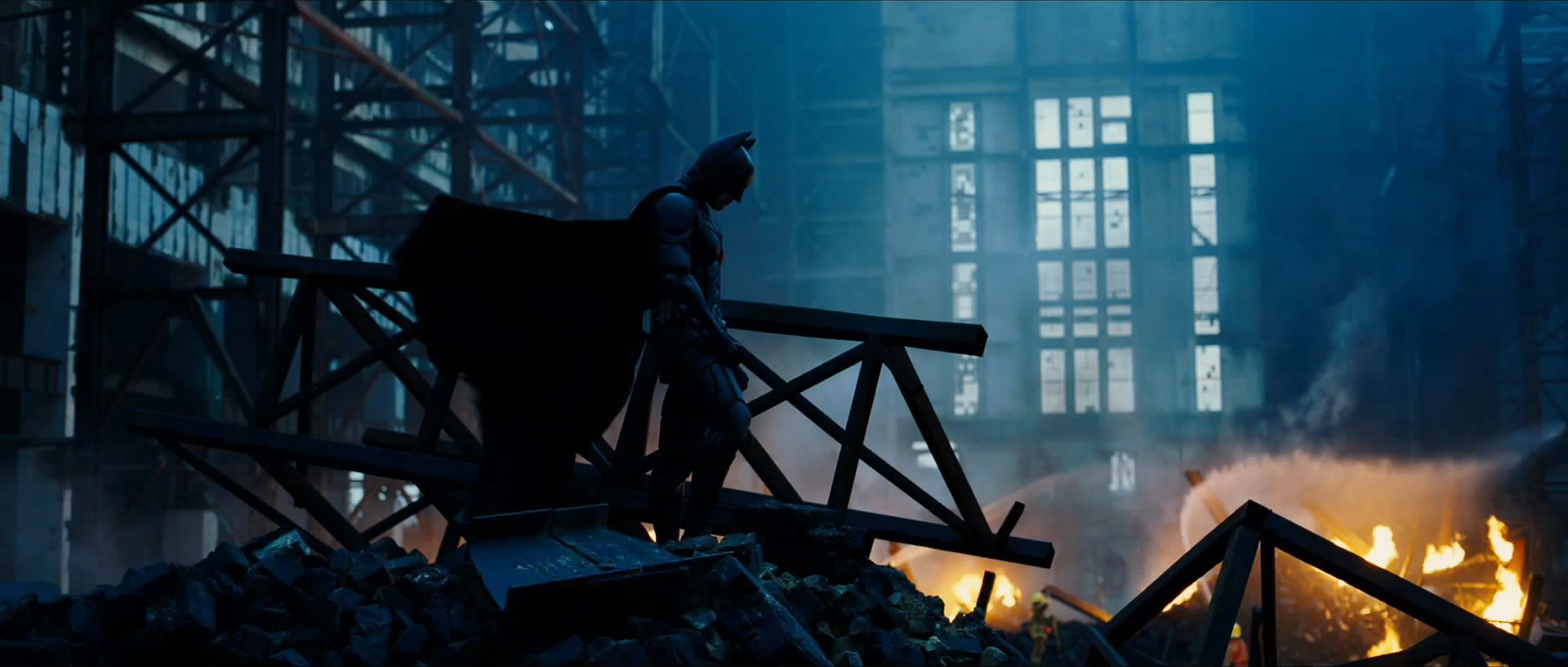
The Dark Knight ****

"Either you die a hero or you live long enough to see yourself become the villain."
- Harvey Dent

This film stands out among superhero films for one reason - it asks the question, "what is a hero?" It has all the fight scenes, chases and gadgets you would expect in a superhero, specifically Batman, movie, but unlike most of these films, it goes in deep beneath the surface of action movie superficiality.

The Dark Knight is far from a perfect film. It has errors, plot holes, and technical annoyances throughout. One such plot hole occurs after Batman rescues Rachel from his penthouse apartment after his party is hijacked by the Joker. (This is not a spoiler as it was reveled in the trailer) After we see that Rachel has been rescued from plummeting to her death, we cut to the next scene. Presumably, Bruce Wayne believed that his guests would be able to fend off the Joker and company by themselves. It gets worse. When Harvey Dent recommends that Rachel go to the safest place in the city, she decides to go back to the Wayne penthouse. After all, it was only broken into by the Joker the night before. The same confusing, breakneck action choreography persists from Batman Begins, as does the lightning pacing that could potentially keep a step ahead of some viewers. Gordon, played by Gary Oldman, mumbles through many of his otherwise excellent lines, while Batman, played by Christian Bale, deliberately overplays his ultra-growly Bat-voice.

Even though this film has many errors, it is a significant improvement on Batman Begins.The returning principal actors are all excellent in this film, so I will focus on the new guys. Heath Ledger's performance (?) as the Joker is the best in the film. What you see in the trailer is a demented freak of a villian, and that is what he is in the film, but what you do not see is that he is a character of geniune humor and is the one who gets the most laughs. Aaron Eckhart also joins, and meshes perfectly with the existing cast. The character arc of his Harvey Dent lends the film a real sense of tragedy as he falls from being the hero to being the villian.

While The Dark Knight is a genuine comic book movie, with fights, gadgets, and witty repartee (especially between Bruce and his butler Alfred (Michael Caine), it has much deeper themes beneath the surface, the central theme being heroism. The film asks this question of Batman during his desperate fight against the Joker, and the answer is that he is farther from the definition of a hero and much closer to something else. Batman is a knight, and a dark one at that.

Seen The Dark Knight? What did you think? Comment! If you enjoyed this review, please subscribe via rss or email, so you don't miss a single one!

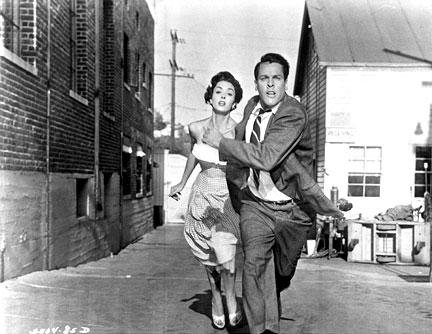
Invasion of the Body Snatchers (1956) ****

Invasion of the Body Snatchers is more of science fiction and paranoia film than a horror flick. The first act is very much a horror film, successfully creating a aura of suspense, but when we see the phenomenon explained, it becomes a science fiction and thriller movie.

The movie is about a doctor who finds that something very strange is happening to the people in his town. People think that their loved ones are impostors even though there are no discernible differences. All this is compounded by the appearance of mysterious seed pods...

The movie is made in standard horror black and white, but director Don Siegel uses it show both bright cheerful suburbs and noir-ish shadowed alleys. The overuse of dutch angles is blatant, but perhaps neccesary to give this film an edge. The contrasting styles certainly work well to communicate what this film is trying to say.

All good science fiction makes you think, and this movie surely does. It forces to think about humanity and what makes us human. It is also a commentary on the homogeneous suburban life of the 50s and the lack of individual expression (a very human trait).

Seen Invasion of the Body Snatchers? What did you think? Comment!